🇮🇹🔍 ItColBERT - An Italian Late-Interaction Retriever
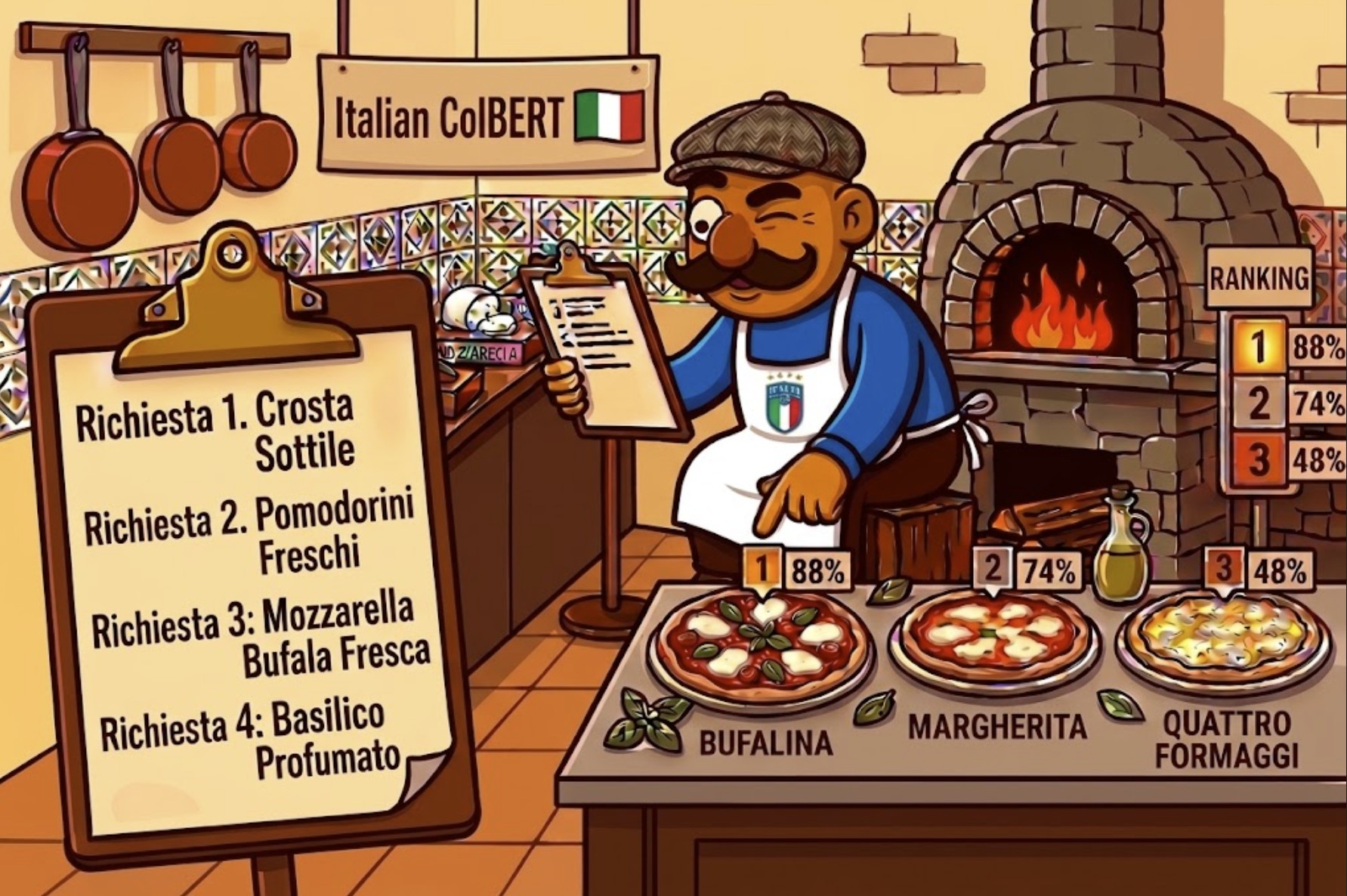
to my knowledge, there was no monolingual Italian ColBERT out there — plenty of multilingual late-interaction models include Italian among dozens of languages, and plenty of strong Italian dense embedders exist, but nothing combined the two: an Italian-specialized model that keeps token-level matching. that gap is what made me want to try building one myself.
the result is ItColBERT, trained end to end on a single RTX 3090 at home, with every design decision, failed experiment and dead end documented along the way rather than hidden. the write-up is also a paper: ItColBERT: An Italian-Specialised Late-Interaction Retriever (arXiv:2609.26856).
🧩 What is Late Interaction?
most retrieval embedding models compress a whole passage into one vector. ColBERT-style late interaction models keep one small vector per token instead, and score a document by matching each query token against its best document token (MaxSim) rather than comparing two averaged blobs.
that keeps fine-grained detail — exact names, numbers, phrasing — that gets blurred away by single-vector compression, at the cost of a larger index. it’s the retrieval approach behind ColBERT / ColBERTv2 from Stanford, and the one PyLate (the library this project is built on) makes practical to train and serve.
🔎 curious how late interaction actually works, step by step? (click to expand)
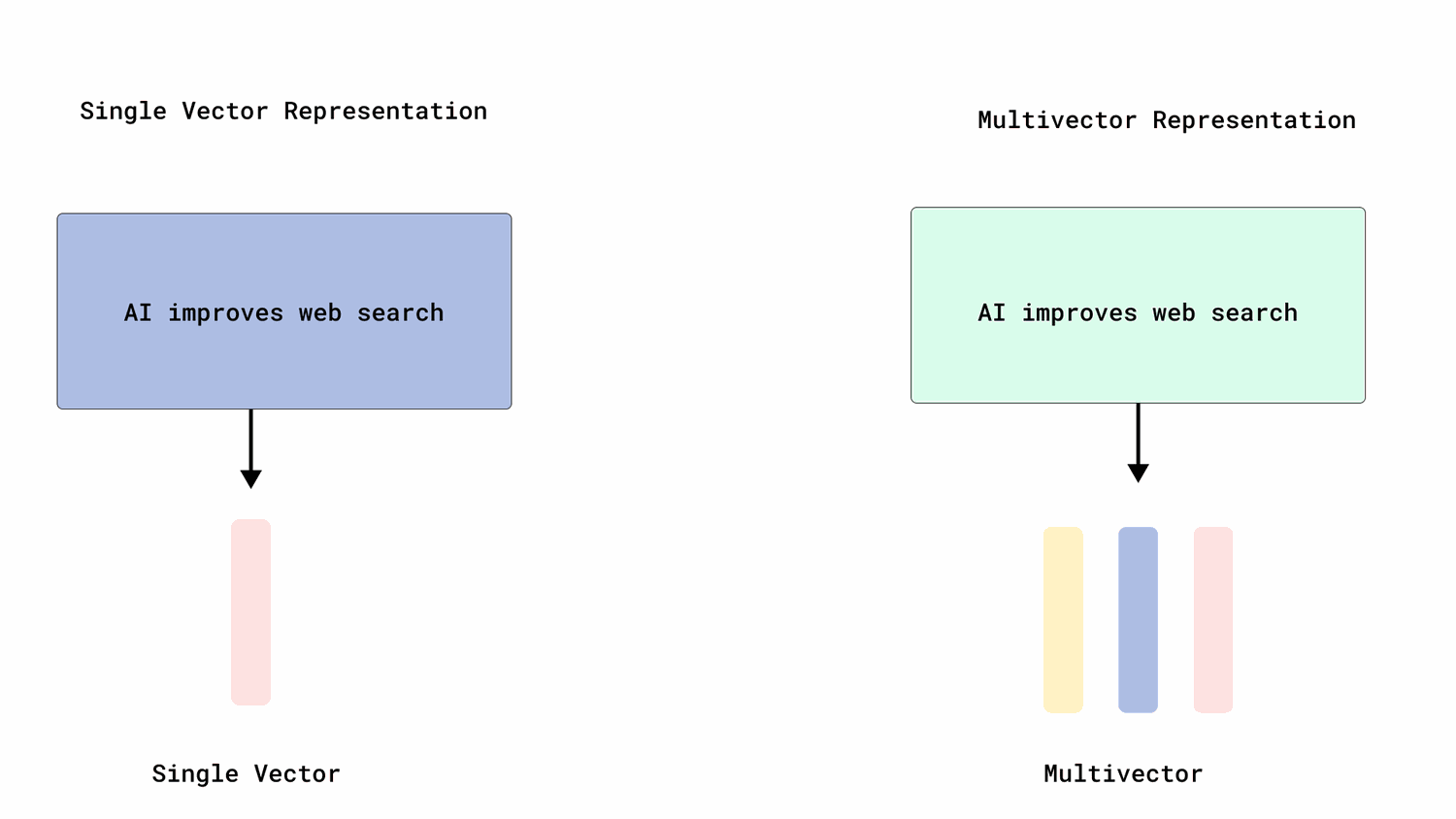
Single vector vs. multi-vector representations
a “normal” dense retriever squeezes an entire passage — however long — into one fixed-size vector, a single point that’s supposed to summarize its whole meaning. a multi-vector representation instead keeps one vector per token: the sentence “AI improves web search” doesn’t become one blob, it becomes four small vectors, one per word, each preserving that word’s own meaning in context.
No interaction vs. early interaction vs. late interaction
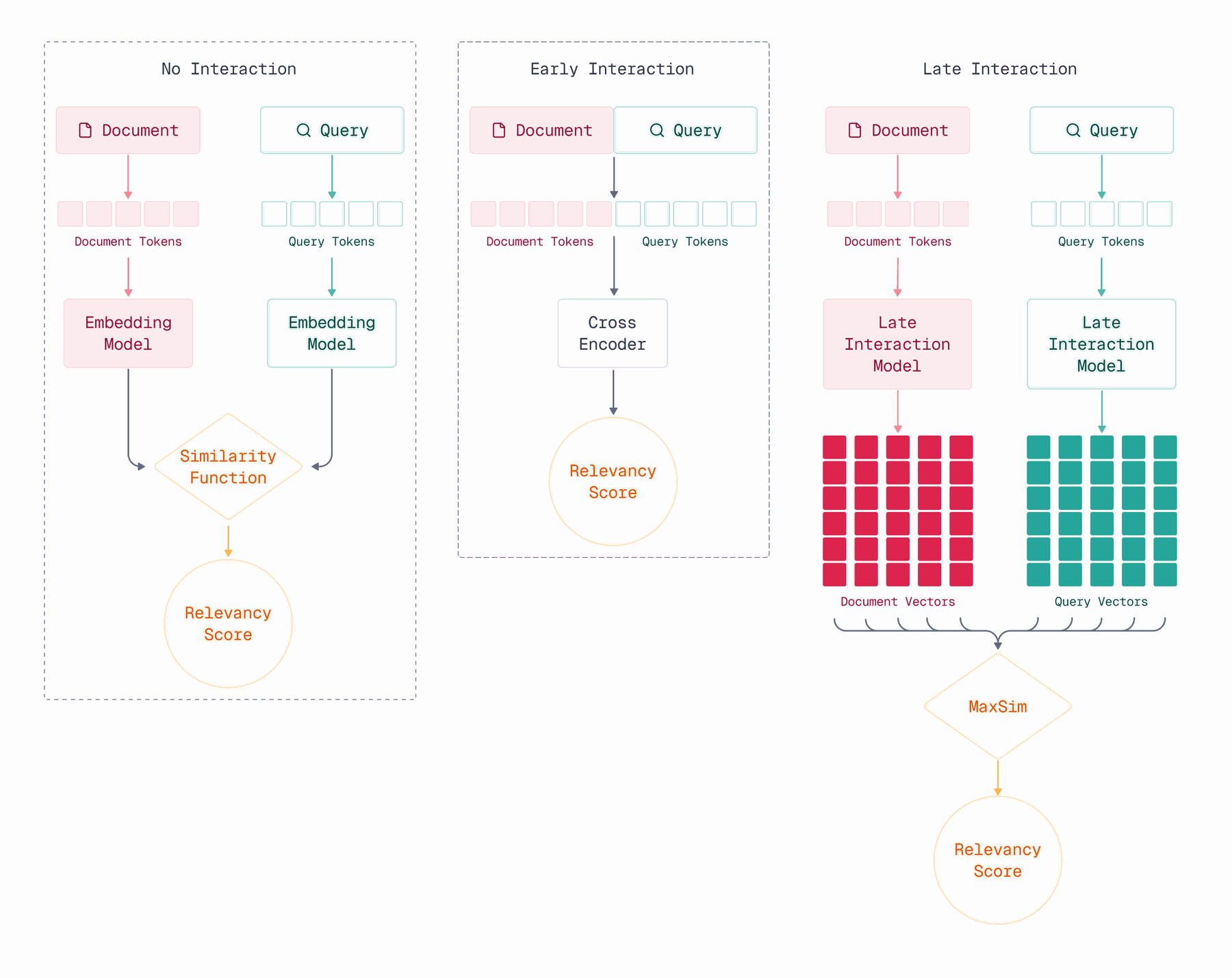
the three retrieval families differ in when the query and the document actually “meet”:
- no interaction (plain dense retrieval / bi-encoders): query and document are each squeezed into a single vector, completely independently, and only compared at the very end via a cheap similarity function (cosine/dot product). every document can be encoded offline, once, and at query time only the query needs encoding — extremely fast, but the model never sees query and document together, so a lot of nuance gets averaged away.
- early interaction (cross-encoders): query and document text are concatenated and pushed through the transformer together, so every document token can attend to every query token through several self-attention layers. this is the most accurate scoring approach — but nothing about the document can be precomputed, so the full model has to rerun per document, per query. too slow to search a whole corpus with; used only to rerank a short candidate list.
- late interaction (ColBERT-style): documents are still encoded independently and fully precomputable offline — but as many token vectors, not one. at query time only the query needs fresh encoding; the actual query↔document comparison happens at scoring time via MaxSim. this recovers much of a cross-encoder’s token-level precision while keeping the expensive part (encoding documents) something done once, offline — not per query.
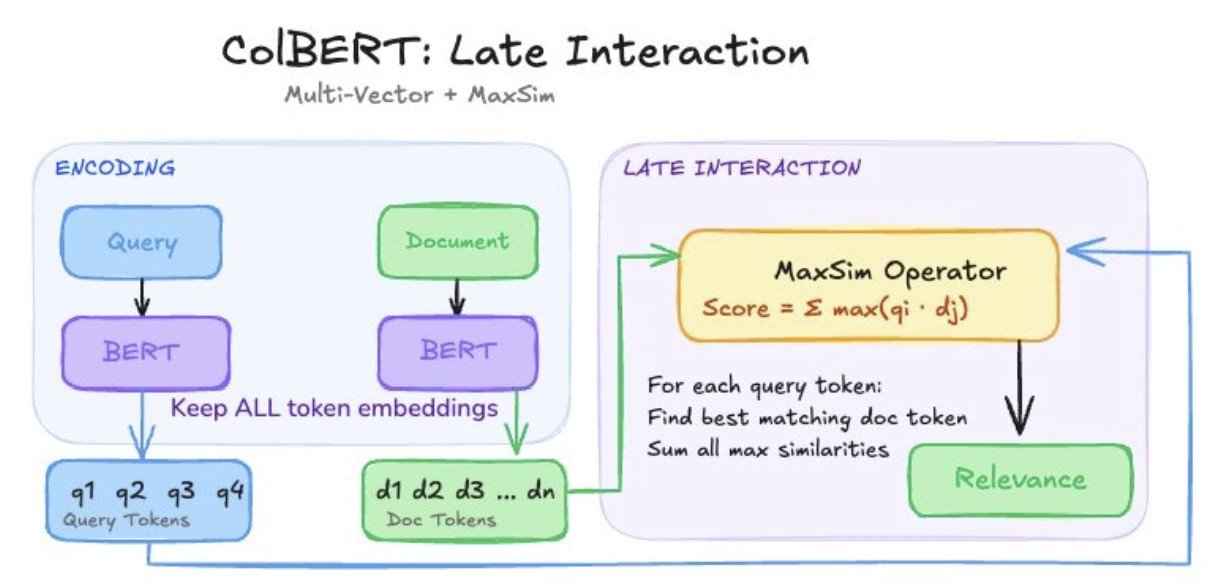
The MaxSim operator, in words
for every single query token, MaxSim looks across all of a document’s token vectors and finds the one that matches best — then adds up these best-matches, one per query token, into the document’s final score. so a document doesn’t need to match the query’s overall meaning; for every individual query token, it just needs somewhere in the text a close match to that specific word. that’s exactly what lets late interaction preserve exact names, numbers and phrasing — the things a single averaged vector blurs away.
A worked example
illustrative numbers below, not real model output (the “Try it” section further down has that) — just enough to make the difference concrete. take one query and two candidate documents:
- query: “capitale Italia” → tokens:
capitale,Italia - doc A: “Roma è la capitale d’Italia” (Rome is the capital of Italy) → tokens (stopwords dropped for readability):
Roma,capitale,d',Italia - doc B: “Milano è la capitale economica del Paese” (Milan is the economic capital of the country) → tokens:
Milano,capitale,economica,Paese
doc A is obviously the right answer to a human. here’s what each architecture actually receives as input, and what it hands back as output.
No interaction (bi-encoder)
1
2
3
4
5
6
7
8
9
OFFLINE — before any query exists
  doc A text ──[Encoder]──► doc A embedding  (1 vector, stored in an index)
  doc B text ──[Encoder]──► doc B embedding  (1 vector, stored in an index)

AT QUERY TIME
  query text ──[Encoder]──► query embedding  (1 vector)

  cosine(query, doc A) = 0.82
  cosine(query, doc B) = 0.79
- input: the query text alone, and each document text alone — the model never sees a query and a document together, ever.
- output: one similarity number per document, compared only after both sides are already reduced to a single vector each.
doc A still edges ahead here, but barely — squeezing “Roma è la capitale d’Italia” down to one vector mixes the fact “capital of Italy” together with everything else in the sentence, so the model can’t specifically tell the query “yes, Italia is mentioned” — it can only compare two blurry overall impressions.
Early interaction (cross-encoder)
1
2
3
AT QUERY TIME — repeated for every candidate document, nothing precomputed
  [query + doc A] ──[Cross-Encoder]──► relevance score = 9.1
  [query + doc B] ──[Cross-Encoder]──► relevance score = 3.4
- input: the query and the document together, fed into the model as one combined sequence, so every word on both sides can directly attend to every other word.
- output: one relevance score per document — but it took a full model pass, per document, to get it, since nothing about doc A or doc B could be computed ahead of time.
much more decisive gap than “no interaction” — the model can directly see “capitale” sitting right next to “d’Italia” in doc A, and that’s missing in doc B. the cost: this has to be redone from scratch for every single candidate document, every single query, which is why cross-encoders only rerank a short list rather than search a whole corpus.
Late interaction (ColBERT / MaxSim)
1
2
3
4
5
6
OFFLINE — before any query exists
  doc A tokens (Roma, capitale, d', Italia)         ──[Encoder]──► 4 token embeddings, stored
  doc B tokens (Milano, capitale, economica, Paese) ──[Encoder]──► 4 token embeddings, stored

AT QUERY TIME
  query tokens (capitale, Italia) ──[Encoder]──► 2 token embeddings
- input: query and document encoded completely separately, same as “no interaction” — but instead of one vector each, every token keeps its own, and document token vectors are computed and stored offline, before any query exists.
- output: not one comparison, but many — every query token is compared against every document token, and only the single best one per row counts toward the final score.
MaxSim(query, doc A) — one row per query token, one column per doc A token, best match per row in bold:
| Roma | capitale | d’ | Italia | |
|---|---|---|---|---|
| capitale | 0.74 | 1.00 | 0.02 | 0.15 |
| Italia | 0.77 | 0.13 | 0.02 | 1.00 |
score(doc A) = 1.00 (capitale) + 1.00 (Italia) = 2.00
MaxSim(query, doc B) — same idea, against doc B’s tokens:
| Milano | capitale | economica | Paese | |
|---|---|---|---|---|
| capitale | 0.35 | 0.96 | 0.23 | 0.68 |
| Italia | 0.12 | 0.12 | 0.12 | 0.74 |
score(doc B) = 0.96 (capitale) + 0.74 (Paese) = 1.70
ranking: doc A (2.00) > doc B (1.70)
both documents match capitale almost perfectly (1.00 and 0.96), since both literally contain that exact word — MaxSim doesn’t get fooled or blurred by that, it just correctly scores it as a strong match on both sides. the ranking is decided by the other query token: Italia finds a near-perfect match inside doc A (the word “Italia” itself, 1.00), but the best match it finds anywhere in doc B is Paese (“country”, 0.74) — related, clearly weaker. that’s the level of detail a single pooled vector throws away, and that a cross-encoder would also catch — but only by paying the full per-document cost that late interaction avoids by precomputing document tokens once, offline.
🎯 Why an Italian-Specialized Model?
before this project, the Italian options were:
- multilingual late-interaction models that include Italian among many languages (
jina-colbert-v2,mLateOn,ColBERT-XM,SauerkrautLM-Multi-ModernColBERT) - strong Italian dense embedders that drop late interaction entirely
not “the first Italian ColBERT” — the models above already cover Italian — but the first one specialized on it.
🛠️ How It Was Built
backbone: nickprock/Italian-ModernBERT-base-embed-mmarco-mnrl → PyLate ColBERT (token vectors, dim 128, MaxSim). starting from a checkpoint that already retrieves, rather than a raw language model, follows the ColBERT-Zero efficiency result: supervised contrastive + distillation from a retrieval-capable init reaches ~99% of full multi-vector pretraining at roughly 10× lower cost.
| stage | what it does |
|---|---|
| phase 1 — contrastive | supervised contrastive training on mMARCO-it triples, reranker-mined hard negatives, Italian Wikipedia retrieval pairs, MIRACL-ita and SQuAD-ita — ~2.4M triplets |
| phase 2 — distillation | KL distillation from a single cross-encoder teacher (mxbai-rerank-large-v2, via LightOn’s dataset), sample budget spread proportionally across all 8 dataset splits |
| checkpoint selection | on retrieval metrics (nDCG@10 / MRR@10), never on hold-out KD loss alone |
🗺️ The Journey (Including What Didn’t Work)
three rounds of work, and two of them were rejected after fair testing — which is arguably the more useful part to write down:
- round 1 — broaden the data, then distil. the starting checkpoint only knew machine-translated mMARCO. added more varied Italian sources, then a distillation stage from a cross-encoder teacher. this became the model that shipped — strongest Italian-specialized late-interaction model tested, weakest on long documents.
- found the long-document weakness was mostly mechanical. the hardest benchmark’s documents run a few thousand words; they were being truncated at 512 tokens, discarding ~80% of the average document. chunking documents at query time — no retraining at all — recovered most of the gap (+0.06 nDCG@10, the largest single gain in the whole project).
- round 2 — mined harder negatives from the model’s own prediction mistakes. no real improvement, and a measurable regression in generalization. rejected.
- round 3 — trained the model to natively read twice as much text per document (1024 vs 512 tokens), instead of relying on query-time chunking. ran a controlled A/B on identical data. statistically indistinguishable from just chunking a normally-trained model, once compared fairly on held-out queries. rejected.
- what shipped: since neither training round beat “train normally, then chunk long documents at query time,” that’s exactly what’s in the released model.
the full numbers behind every one of these steps — including the significance testing, not just the headline deltas — are in TODO.md in the repo.
📊 Results
real numbers, paired-bootstrap significance tested. † = not statistically distinguishable from ItColBERT (p > .05) — read those as ties regardless of which number is higher.
| Model | MLDR-it (nDCG@10) | mMARCO-it (MRR@10) | MIRACL-ita (nDCG@10) | SQuAD-ita (nDCG@10) |
|---|---|---|---|---|
| ItColBERT | 0.4008 (0.4610 chunked) | 0.7196 | 0.7194 | 0.9026 |
| mLateOn | 0.4623 | 0.8207 | 0.7880 | 0.9480 |
| jina-colbert-v2 | 0.3858 † | 0.8389 | 0.7755 | 0.8849 |
| bge-m3 (dense) | 0.4531 | 0.7812 | 0.7566 | 0.8247 |
| multilingual-e5-large (dense) | 0.4310 † | 0.8239 | 0.7653 | 0.8513 |
| SauerkrautLM-Multi-ModernColBERT | 0.3122 | 0.5342 | 0.5996 | 0.8338 |
| ColBERT-XM | 0.2734 | 0.6654 | 0.6260 | 0.8558 |
| BM25 | 0.4850 (vs. 0.4610 chunked: †) | 0.5715 | 0.5516 | 0.8262 |
the strongest Italian-specialized late-interaction model tested here, beating every general-purpose late-interaction alternative except one (mLateOn, the strongest multilingual late-interaction model found). behind large multilingual dense embedders on most benchmarks — matching those was never the goal, they’re a different model class.
🪶 Small but Capable
one point worth calling out on its own: ItColBERT is the smallest model in the whole comparison — and it isn’t close.
| Model | Parameters | MLDR-it (nDCG@10) |
|---|---|---|
| ItColBERT | ~135M | 0.4008 (0.4610 chunked) |
| SauerkrautLM-Multi-ModernColBERT | 149M | 0.3122 |
| ColBERT-XM | 277M | 0.2734 |
| mLateOn | 307M | 0.4623 |
| multilingual-e5-large (dense) | 560M | 0.4310 † |
| bge-m3 (dense) | 568M | 0.4531 |
| jina-colbert-v2 | ~0.6B | 0.3858 † |
built on ModernBERT-base rather than one of the ~560M-parameter multilingual giants, ItColBERT still comes out ahead of SauerkrautLM-Multi-ModernColBERT (roughly the same size class), ColBERT-XM (2× the parameters), and statistically ties jina-colbert-v2 (~4.4× the parameters) on the primary out-of-domain benchmark. mLateOn is the one model that beats it outright while also being smaller than the dense giants — worth being upfront about rather than glossing over.
being 4× smaller than the multilingual giants and still landing in the same neighborhood matters in practice: smaller index footprint, cheaper inference, and it’s realistic to fine-tune or run fully offline on a single consumer GPU — which is exactly how the whole thing was built and evaluated in the first place.
🚀 Try It
1
pip install -U pylate
1
2
3
4
5
6
7
8
9
10
11
12
13
14
15
16
17
18
19
20
21
22
from pylate import rank, models

model = models.ColBERT(model_name_or_path="enricollen/ItColBERT")

queries = ["Qual è la capitale d'Italia?"]
documents = [[
    "Roma è la capitale d'Italia.",
    "Milano è la capitale economica del Paese.",
]]
documents_ids = [[1, 2]]

queries_embeddings = model.encode(queries, is_query=True)
documents_embeddings = model.encode(documents, is_query=False)

reranked = rank.rerank(
    documents_ids=documents_ids,
    queries_embeddings=queries_embeddings,
    documents_embeddings=documents_embeddings,
)
print(reranked)
# [[{'id': 1, 'score': 31.682}, {'id': 2, 'score': 31.552}]]
# one list per query, sorted highest score first — "Roma" wins, as expected.
model card, indexing recipe for full corpora, and the long-document chunking trick are all on the Hugging Face page.
💻 Hardware
everything — every training run, every benchmark, all significance testing — was done on one consumer machine, not a cluster:
- CPU: Intel Core i7-14700K
- GPU: NVIDIA RTX 3090 (24GB)
- RAM: 32GB (27GB usable under WSL2)
no multi-GPU, no cloud compute. that ceiling shaped quite a few decisions along the way — mini-batch sizes, chunking’s ~26GB host-RAM cost, a couple of OOM kills documented in the repo.
⚠️ Limitations & What’s Next
- MIRACL-ita and SQuAD-ita are community machine translations, not official benchmark resources — labelled as such everywhere they’re used
- behind large multilingual dense embedders on most axes; the goal here was an Italian-specialized late-interaction model, not beating general-purpose giants
- next candidates on the list: RRF fusion with BM25 (looks like the cheapest real gain left), a dim-64 variant for smaller indexes, and pinning dataset revisions for full reproducibility
🔗 Links
- 📄 Paper: ItColBERT: An Italian-Specialised Late-Interaction Retriever — Nello, E. (2026). arXiv:2609.26856. doi:10.48550/arXiv.2609.26856
- 🐙 GitHub repository: github.com/enricollen/it-colbert — training code, benchmark suite, and the full development history (if you find it useful, a star ⭐ is always appreciated)
- 🤗 Model on Hugging Face: huggingface.co/enricollen/ItColBERT — ready-to-use weights, model card, and usage examples
🎬 Conclusion
this was as much a project about measurement discipline as it was about training a model. two separate training-based attempts (harder negatives, training at longer document length) both failed to beat a training-free trick (chunking) that only surfaced because I bothered to check where the truncation was actually happening. that’s the actual lesson from this project — not every improvement needs more GPU hours, sometimes it needs a better look at the data first.
if you work with Italian text search or RAG and want token-level retrieval without going multilingual, give it a try and let me know how it performs on your data.